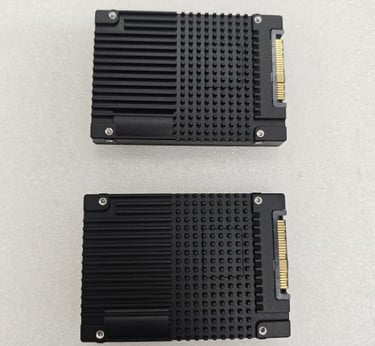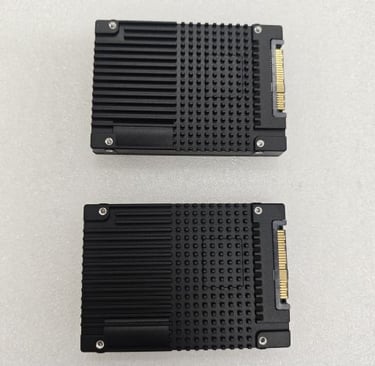
🔥 Beyond Capacity: How to Architect Smarter Storage with Micron 9400 Pro and 6500 ION
ELECTRONICS
4/15/20264 min read
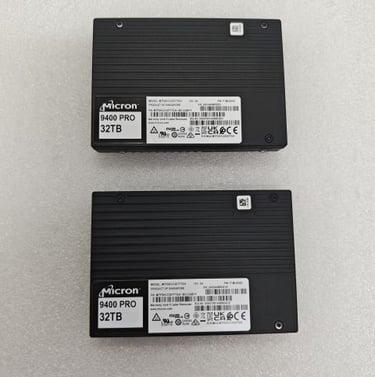
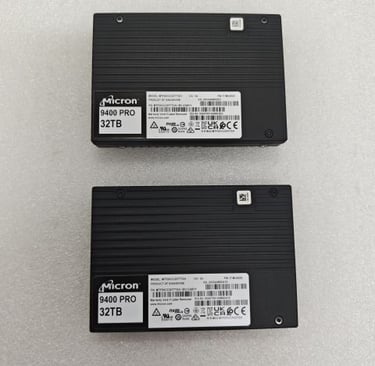
The enterprise storage landscape is evolving at a pace that feels almost disorienting. Capacities are exploding. Workloads are fragmenting. Budgets are tightening. And somewhere in the middle of all this complexity, a deceptively simple question keeps surfacing:
If two SSDs offer the same 30.72TB capacity, why do they behave so differently in production?
That question sits at the heart of the comparison between the Micron 9400 Pro and the Micron 6500 ION. On paper, they look similar—identical capacity, enterprise pedigree, NVMe architecture. But in reality, they occupy entirely different roles inside a modern data center.
Understanding that difference isn’t just useful. It’s critical.
🧠 The Illusion of Capacity: Why 30.72TB Doesn’t Tell the Whole Story
Capacity is seductive. It’s easy to compare. Easy to quantify. Easy to sell.
But it’s also misleading.
Two drives can share the same raw capacity and still deliver radically different outcomes depending on latency profiles, endurance curves, firmware optimization, and NAND architecture. Capacity, in isolation, is just storage potential. What matters is how that capacity behaves under pressure.
The Micron 9400 Pro is engineered for intensity—rapid transactions, relentless IOPS demands, environments where delays are unacceptable. The 6500 ION, on the other hand, is built for scale—massive datasets, distributed systems, and cost-efficient expansion.
Same size. Different philosophy.
⚡ Micron 9400 Pro: Where Performance Is Non-Negotiable
There are environments where speed isn’t a luxury—it’s survival.
Think about OLTP systems. Thousands, sometimes millions, of transactions per second. Each query demanding immediate response. Each delay compounding into user dissatisfaction, financial loss, or system instability.
This is where the 9400 Pro thrives.
It doesn’t just perform well. It performs predictably.
Latency remains tight, even under heavy load. QoS consistency ensures that the 99.9999th percentile doesn’t spiral out of control. And that’s the difference between a system that works in testing and one that survives in production.
🔹 Key Workloads for 9400 Pro
High-frequency trading systems
Financial transaction databases
Real-time analytics engines
Core relational databases (MySQL, Oracle, SQL Server)
HPC clusters requiring deterministic performance
Virtualized environments with dense VM stacking
In these environments, milliseconds matter. Sometimes microseconds.
And when performance degrades, everything downstream suffers.
🌊 Micron 6500 ION: Scaling Without Breaking the Budget
Now shift perspective.
Imagine a data lake. Petabytes of information. Logs, images, training datasets, backups. The workload is massive, but not necessarily latency-sensitive. Throughput matters. Cost matters more.
This is the domain of the 6500 ION.
It’s not trying to win benchmark races. It’s trying to win efficiency battles.
Built on advanced 232-layer NAND, the 6500 ION delivers a fascinating balance: TLC-level reliability with a cost structure that approaches QLC territory. That’s not incremental improvement—that’s strategic disruption.
🔹 Ideal Use Cases for 6500 ION
Object storage systems (Ceph, MinIO)
Big data platforms (Hadoop, Spark)
AI/ML training datasets
Content delivery networks (CDN)
Cold and warm storage tiers
Large-scale NoSQL databases
In these scenarios, the goal isn’t ultra-low latency. It’s maximum capacity per dollar, without sacrificing reliability.
⚖️ Performance vs Efficiency: A False Dichotomy?
It’s tempting to frame this as a binary choice.
Performance or capacity. Speed or scale. Premium or efficient.
But that framing is outdated.
Modern data centers don’t choose one—they orchestrate both.
The real advantage comes from tiered storage architecture.
🧩 Storage Tiering: The Real Strategy Behind Modern Infrastructure
Here’s where things get interesting.
Instead of forcing one drive to do everything, smart architectures assign roles:
Hot Tier → 9400 Pro
Warm/Cold Tier → 6500 ION
This isn’t just optimization. It’s transformation.
Hot data—frequently accessed, latency-sensitive—lives on high-performance drives. Cold data—archival, analytical, bulk storage—resides on high-capacity, cost-efficient drives.
The result?
Lower overall cost
Higher system performance
Better resource utilization
And perhaps most importantly, scalability without compromise
📊 The Economics of NAND: Why 6500 ION Changes the Game
Let’s talk about cost.
Traditionally, TLC and QLC have occupied different tiers. TLC offered better performance and endurance. QLC offered lower cost but compromised on write performance.
The 6500 ION disrupts that balance.
By leveraging advanced NAND layering, it narrows the gap—delivering significantly better write performance than QLC while approaching its cost structure.
That creates a new category:
👉 High-capacity SSDs that don’t force painful trade-offs
And in a market where SSD prices—especially at 30TB+—have surged dramatically, that matters more than ever.
📈 Market Reality: Supply Constraints and Strategic Choices
The enterprise storage market isn’t operating in a vacuum.
Supply constraints. Price volatility. Extended lead times.
These aren’t temporary anomalies—they’re structural challenges.
High-capacity SSDs have seen dramatic price increases. Availability fluctuates. Planning cycles are disrupted.
In this environment, the question shifts:
It’s no longer “What’s the best drive?”
It becomes:
👉 What can you reliably deploy at scale?
And that’s where having both 9400 Pro and 6500 ION in stock becomes a strategic advantage.
🚀 Real-World Deployment Scenarios
Let’s move beyond theory.
Scenario 1: Financial Services Platform
Transaction database → 9400 Pro
Historical data archive → 6500 ION
Result: lightning-fast transactions + cost-efficient storage
Scenario 2: AI Training Infrastructure
Active training datasets → 9400 Pro
Raw data lake → 6500 ION
Result: faster model training + scalable data ingestion
Scenario 3: CDN Provider
Edge caching → 9400 Pro
Content repository → 6500 ION
Result: faster delivery + lower storage costs
🔍 The Hidden Advantage: Predictability
Performance is important.
Capacity is important.
But predictability? That’s the hidden advantage.
The 9400 Pro delivers consistent latency under pressure. The 6500 ION delivers consistent cost efficiency at scale.
Together, they create a system that behaves as expected.
And in enterprise environments, that’s invaluable.
🧠 Choosing the Right Drive: A Practical Framework
Instead of asking “which is better,” ask:
Is my workload latency-sensitive? → 9400 Pro
Is my workload capacity-driven? → 6500 ION
Do I need both? → Tier your storage
Simple questions. Powerful outcomes.
📦 Stock Availability: Ready When You Need It
Both models—Micron 9400 Pro and 6500 ION 30.72TB—are available now, factory sealed, ready to ship from Hong Kong.
In a market defined by uncertainty, availability itself becomes value.
🤝 Partner with a Stable Supply Source
When infrastructure decisions depend on timing, reliability, and cost control, your supply partner matters just as much as your hardware.
Leon Wholesale provides:
Stable inventory
Flexible logistics (Hong Kong & Shenzhen)
Bulk order consistency
Enterprise-grade sourcing support
📌 Seller: Leon Wholesale
📞 WhatsApp: +8618136773114
📧 Email: leonxu0317@gmail.com
🧾 Final Thoughts: It’s Not About the Drive — It’s About the Design
The Micron 9400 Pro and 6500 ION aren’t competitors.
They’re complements.
One delivers speed. The other delivers scale. And together, they enable something far more valuable:
👉 A storage architecture that adapts to your workload, not the other way around
In a world where data is growing faster than ever, that flexibility isn’t optional.
It’s essential.
#Micron #9400Pro #6500ION #EnterpriseSSD #DataCenterStorage #NVMe #PCIe4 #StorageTiering #HighCapacityStorage #AIStorage #Ceph #CloudInfrastructure #ITProcurement #B2BHardware #HongKongStock #TechDecision