
🚀 The Enterprise Storage Atlas: A Deep Dive into Samsung, Solidigm, Kioxia & Seagate Data Center SSD and HDD Ecosystems
ELECTRONICS
4/15/20264 min read
In today’s enterprise infrastructure landscape, storage is no longer just a component—it is the foundation of digital operations. From AI training clusters to hyperscale cloud environments, every workload ultimately depends on one thing: reliable, scalable, and strategically tiered storage architecture.
Yet procurement teams are often overwhelmed by a simple but critical challenge:
👉 Too many models. Too many capacities. Too many interfaces.
👉 And not enough clarity on where each drive actually belongs.
This guide breaks down a structured view of enterprise storage using real-world product lines from Samsung, Solidigm, Kioxia, and Seagate, mapping each family into a practical deployment strategy.
🧠 Understanding Modern Storage Architecture: It’s Not About One Drive Anymore
Modern data centers are no longer built around a single storage type. Instead, they rely on layered infrastructure, typically divided into:
🔴 Hot Tier (Ultra-low latency workloads)
🟡 Warm Tier (Balanced performance & capacity)
🔵 Cold Tier (High-capacity archival storage)
Each tier requires different characteristics:
NVMe PCIe 4.0 / 5.0 for speed
SATA/SAS for cost efficiency
High-capacity HDDs for bulk storage
The key is not choosing the “best drive,” but choosing the right drive for the right workload.
⚡ Samsung PM893: The SATA Workhorse for Stable Enterprise Deployment
The Samsung PM893 series represents the SATA reliability tier in enterprise SSD design.
📦 Models:
MZ7L3240HCHQ-00A07 — 240GB
MZ7L3480HCHQ-00A07 — 480GB
MZ7L3960HCJR-00A07 — 960GB
MZ7L31T9HBLT-00A07 — 1.92TB
MZ7L33T8HBLT-00B7C — 3.84TB
🧩 Where PM893 Fits:
This lineup is not about performance extremes. It is about:
predictable SATA latency
stable endurance
enterprise boot and system workloads
cost-efficient deployment at scale
🖥️ Typical Use Cases:
OS boot drives for servers
light database workloads
virtualization storage pools
read-heavy enterprise applications
Simple. Stable. Widely deployed.
🚀 Samsung PM9A3: PCIe 4.0 NVMe for Balanced High Performance
The PM9A3 series marks Samsung’s transition into balanced NVMe enterprise storage.
📦 Models:
U.2 960GB / 1.92TB / 3.84TB / 7.68TB / 15.36TB
M.2 960GB (Original / bulk variants)
🧠 Core Identity:
PM9A3 sits between extreme performance and cost efficiency.
It is designed for:
consistent NVMe throughput
virtualization clusters
cloud application workloads
database acceleration layers
⚙️ Deployment Scenarios:
VMware / Hyper-V clusters
SQL / Oracle database caching
containerized microservices
mixed I/O enterprise workloads
It is the “default NVMe choice” for many enterprise environments.
⚡ Samsung PM9D3a: PCIe 5.0 Era Performance Architecture
The PM9D3a series represents Samsung’s entry into PCIe Gen5 enterprise SSDs.
📦 Models:
960GB / 1.92TB / 3.84TB / 7.68TB / 15.36TB
U.2 and E1.S form factors
🚀 Key Evolution:
Compared to PCIe 4.0:
significantly higher throughput
reduced latency ceilings
optimized AI and HPC workloads
🧠 Ideal Applications:
AI training clusters
real-time analytics
HPC simulations
high-frequency transactional systems
This is where storage becomes a compute accelerator, not just a data repository.
🧱 Samsung PM1653 SAS: Enterprise Stability for Legacy Infrastructure
Despite NVMe dominance, SAS remains deeply embedded in enterprise systems.
📦 Models:
960GB to 15.36TB range
MZILG series SAS drives
🧠 Why SAS Still Matters:
backward compatibility with enterprise arrays
predictable performance under mixed workloads
mature enterprise ecosystem
🖥️ Use Cases:
storage arrays
enterprise SAN systems
hybrid infrastructure environments
SAS is not outdated—it is stable infrastructure continuity.
🚀 Samsung PM1743: PCIe 5.0 Ultra High Performance SSD
The PM1743 represents Samsung’s high-end PCIe 5.0 flagship NVMe SSD.
📦 Model:
MZWLO7T6HBLA-00A07 — 7.68TB
⚡ Key Characteristics:
extreme throughput performance
optimized for next-gen compute workloads
designed for AI and HPC scaling
🧠 Deployment Focus:
AI inference pipelines
GPU cluster storage
hyperscale compute environments
This is where storage meets real-time computation demand.
🌐 Solidigm S4520 & S4620: Cost-Optimized SATA Enterprise SSDs
Solidigm continues Intel’s legacy in SATA enterprise storage.
📦 Models:
S4520 7.68TB SATA
S4620 3.84TB SATA
🧠 Core Strength:
cost-efficient large-scale deployment
predictable SATA behavior
enterprise-grade endurance
🖥️ Use Cases:
cold storage
backup infrastructure
secondary database layers
These drives prioritize scale over speed.
⚡ Solidigm P5520: NVMe 4.0 Enterprise Balance Point
📦 Models:
3.84TB U.2
7.68TB U.2
🧠 Positioning:
PCIe 4.0 NVMe
balanced latency and throughput
optimized for general enterprise workloads
🖥️ Use Cases:
virtualization
cloud applications
database acceleration
A “safe default” NVMe choice for enterprise planners.
🧬 Kioxia CD8-R: NVMe Reliability for Data-Intensive Workloads
📦 Model:
KCD8XRUG3T84 — 3.84TB U.2 PCIe 4.0
🧠 Strengths:
high endurance NAND architecture
consistent enterprise reliability
strong read/write balance
🖥️ Applications:
data analytics
virtualization clusters
enterprise applications
Kioxia focuses on long-term stability under sustained workloads.
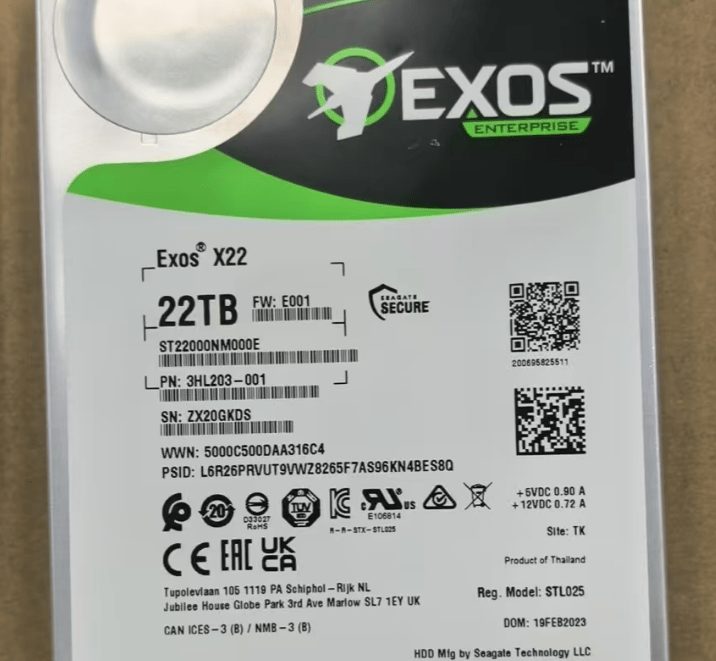
🧊 Seagate Exos HDD Series: The Foundation of Bulk Storage
While SSDs dominate performance tiers, HDDs remain essential for capacity economics.
📦 Key Families:
Exos 7E10 Series:
4TB / 8TB / 10TB
Exos X18 / X20 / X24 Series:
16TB to 24TB range
Exos M Series:
30TB / 32TB ultra-capacity HDDs
🧠 HDD Role in Modern Architecture
HDDs are not “slow storage” anymore—they are:
cold data repositories
archival systems
object storage backends
surveillance storage layers
They provide:
unmatched cost per TB
massive scaling potential
long-term retention efficiency
⚖️ The Real Strategy: Multi-Tier Storage Engineering
Modern infrastructure is no longer about choosing SSD vs HDD.
It is about orchestration:
🔴 Tier 1 — Performance Layer
Samsung PM9D3a
PM1743
Solidigm P5520
🟡 Tier 2 — Balanced Layer
Samsung PM9A3
Kioxia CD8-R
Solidigm P5520
🔵 Tier 3 — Capacity Layer
Seagate Exos 20TB–32TB series
⚫ Tier 4 — Legacy / SATA Stability
Samsung PM893
Solidigm S4620/S4520
PM1653 SAS
📈 Market Reality: Why Procurement Is Getting Harder
Enterprise storage is facing structural pressure:
NAND supply volatility
SSD price fluctuations
increasing AI-driven demand
extended lead times
This shifts procurement strategy from:
👉 “Which product is best?”
to
👉 “Which product is available, stable, and scalable?”
🧭 Strategic Insight: Storage Is Now an Engineering Decision
Choosing storage is no longer a purchasing task.
It is a system design decision involving:
workload profiling
latency requirements
cost optimization
lifecycle planning
The combination of Samsung, Solidigm, Kioxia, and Seagate creates a full-stack ecosystem that enables end-to-end infrastructure design.
🧩 Final Perspective: No Single Drive Can Solve Everything
There is no universal “best SSD.”
There is only:
the right SSD for performance
the right SSD for scale
the right HDD for capacity
When combined correctly, they form a balanced, resilient, and cost-efficient storage architecture.
📌 Seller: Leon Wholesale
📞 WhatsApp: +8618136773114
📧 Email: leonxu0317@gmail.com
#Hashtags
#EnterpriseSSD #DataCenterStorage #SamsungSSD #Solidigm #Kioxia #SeagateExos #NVMe #PCIe4 #PCIe5 #SASStorage #HDD #StorageArchitecture #ITProcurement #CloudInfrastructure #AIStorage #BigData #ServerStorage #B2BHardware #HongKongStock #StorageSolutions #TechInfrastructure