
From Chaos to Control: Why One SSD Capacity Can Transform Your Entire Deployment Strategy
ELECTRONICS
4/14/20264 min read
In the ever-evolving world of enterprise IT, flexibility is often praised as the ultimate virtue. More options, more configurations, more customization—on paper, it all sounds ideal. But step into the real world of data centers, system integrators, and large-scale deployments, and a different narrative begins to unfold.
Complexity creeps in. Quietly at first. Then all at once.
What starts as a well-intentioned strategy—offering multiple SSD capacities—can quickly spiral into operational friction, procurement headaches, and inconsistent delivery timelines.
This article explores a powerful yet often overlooked strategy: standardizing on a single SSD capacity. Not as a limitation—but as a lever for efficiency, scalability, and reliability.
The Illusion of Flexibility in SSD Selection
At first glance, offering multiple SSD capacities seems like the right move.
After all, different clients have different needs:
Some require lightweight storage for basic workloads
Others demand larger capacities for data-intensive applications
Pricing tiers can be adjusted based on configuration
It feels like you're building a flexible, customer-centric system.
But here's the catch:
Flexibility at the planning stage often becomes fragmentation during execution.
And fragmentation is expensive.
When Theory Meets Reality: A Deployment Case Study
Let’s consider a real-world scenario.
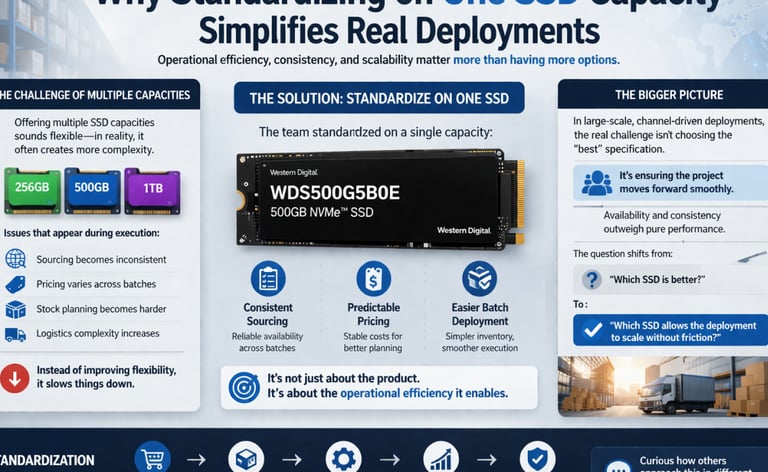
A distributor preparing systems in batches for resale decided to offer three SSD capacity options:
256GB
500GB
1TB
From a sales perspective, this seemed perfect—covering entry-level, mid-range, and high-capacity needs.
But once deployment began, problems surfaced.
Not dramatic failures. Subtle inefficiencies. The kind that compound over time.
The Hidden Costs of Multiple SSD Capacities
Inconsistent Sourcing
Different capacities often come from different supply streams.
Even within the same brand, availability fluctuates. One week the 256GB model is abundant; the next week it's backordered.
Procurement teams are forced to juggle suppliers, negotiate multiple deals, and constantly adjust sourcing strategies.
Consistency disappears.
Pricing Volatility Across Batches
With multiple SKUs, pricing becomes unpredictable.
Bulk discounts vary
Supplier pricing shifts
Currency fluctuations hit differently per model
The result?
Two identical system batches may end up with different cost structures—simply because the SSD mix changed.
That’s a nightmare for margin control.
Stock Planning Becomes a Puzzle
Inventory management thrives on predictability.
Introduce multiple SSD capacities, and suddenly:
Forecasting demand becomes guesswork
Overstocking one capacity becomes inevitable
Understocking another leads to delays
Warehouse teams are left balancing mismatched inventory like a game of Tetris—with no winning move.
Logistics Complexity Multiplies
More SKUs mean:
More labeling
More tracking
More chances for error
Picking the wrong SSD during assembly? It happens.
Shipping the wrong configuration? Even worse.
Each additional capacity option increases operational friction.
The Turning Point: Choosing Simplicity Over Variety
Faced with these growing inefficiencies, the distributor made a decisive shift.
They eliminated complexity.
They standardized on a single SSD model:
500GB NVMe SSD
Not the cheapest. Not the largest. Not even the fastest available.
But it hit the sweet spot.
Why 500GB Became the Optimal Standard
The decision wasn’t random—it was strategic.
Balanced Capacity
500GB provides enough storage for:
Operating systems
Standard enterprise applications
Moderate data workloads
It satisfies the majority of use cases without over-provisioning.
Stable Supply Availability
Mid-range capacities tend to have:
Higher production volumes
More consistent availability
Lower risk of sudden shortages
This makes sourcing significantly more reliable.
Cost Efficiency at Scale
500GB SSDs often sit in the “volume sweet spot”:
Better pricing per unit compared to lower capacities
Less waste compared to oversized drives
Easier to negotiate bulk deals
Predictable pricing leads to predictable margins.
Operational Efficiency: The Real Game-Changer
The most important takeaway?
The value wasn’t in the SSD itself. It was in what standardization enabled.
Streamlined Procurement
With a single SKU:
Supplier relationships become simpler
Bulk purchasing becomes more effective
Negotiations become stronger
Procurement shifts from reactive to strategic.
Simplified Inventory Management
Inventory teams benefit immediately:
One SKU to track
One demand curve to forecast
Reduced risk of dead stock
Efficiency increases. Waste decreases.
Faster Deployment Cycles
Assembly lines move faster when:
Components are standardized
Decisions are minimized
Errors are reduced
Time-to-market improves.
Consistency Across Batches
Every system becomes predictable.
Same performance baseline
Same cost structure
Same deployment process
This consistency is invaluable for scaling operations.
Rethinking “Performance” in Enterprise Environments
Traditionally, IT decisions revolve around performance metrics:
Read/write speeds
IOPS
Latency
But at scale, a different metric becomes more important:
Operational performance.
Ask yourself:
How quickly can systems be deployed?
How reliably can supply be maintained?
How easily can inventory be managed?
These factors often outweigh raw hardware specs.
The Shift in Mindset: From Specs to Scalability
This leads to a fundamental shift in thinking.
Instead of asking:
“Which SSD is technically superior?”
Forward-thinking teams ask:
👉 “Which SSD enables smooth, scalable deployment?”
It’s a subtle change.
But it transforms decision-making.
Standardization as a Strategic Advantage
Standardizing on one SSD capacity isn’t about limitation.
It’s about control.
It allows organizations to:
Reduce uncertainty
Increase efficiency
Scale operations with confidence
In fast-moving markets, these advantages are critical.
Addressing Common Concerns About Standardization
Of course, not everyone is immediately convinced.
Let’s address a few common objections.
“What About Customers Who Need More Storage?”
Simple.
Offer upgrades as exceptions—not the default.
Standard configuration: 500GB
Optional upgrade: 1TB or higher
This keeps the core operation streamlined while preserving flexibility.
“Doesn’t This Limit Customization?”
Yes—and that’s the point.
Controlled limitation reduces chaos.
Too much customization can cripple scalability.
“What If Pricing Changes?”
With a single SKU, you’re better positioned to:
Lock in long-term pricing
Negotiate volume discounts
Build stable supplier relationships
Standardization actually reduces pricing risk.
The Role of Reliable Supply Partners
None of this works without a dependable supply chain.
Consistency requires:
Ready stock availability
Fast global delivery
Reliable second sources
Avoiding OEM delays becomes critical—especially in volatile markets.
A strong supply partner ensures that your standardized strategy doesn’t break under pressure.
Scaling Without Friction: The Ultimate Goal
At the end of the day, enterprise deployments aren’t just about hardware.
They’re about execution.
Smooth execution.
Frictionless scaling.
Predictable outcomes.
Standardizing SSD capacity is one of the simplest—and most effective—ways to achieve this.
Final Thoughts: Simplicity Wins at Scale
Complex systems don’t scale well.
Simple systems do.
By reducing variables, you increase control.
By increasing control, you improve performance—not just at the device level, but across the entire operation.
So the next time you're planning a deployment strategy, consider this:
Not how many options you can offer.
But how few you actually need.
Because sometimes, the smartest move isn’t adding flexibility.
It’s removing complexity.
Contact Us
If you're looking for a reliable second source for SSDs, HDDs, and server components—with ready stock and fast global delivery—Leon Wholesale is here to support your deployment needs.
Leon Wholesale
WhatsApp: +8618136773114
Email: leonxu0317@gmail.com
Hashtags
#EnterpriseIT #StorageStrategy #NVMeStorage #ITInfrastructure #SystemDeployment #SupplyChain #DataCenter #SSDDeployment #TechOperations #ScalableInfrastructure