
Inside the Enterprise SSD Market: From Model Numbers to Real-World Deployment Value
ELECTRONICS
4/27/20263 min read
The Hidden Language of Enterprise Storage
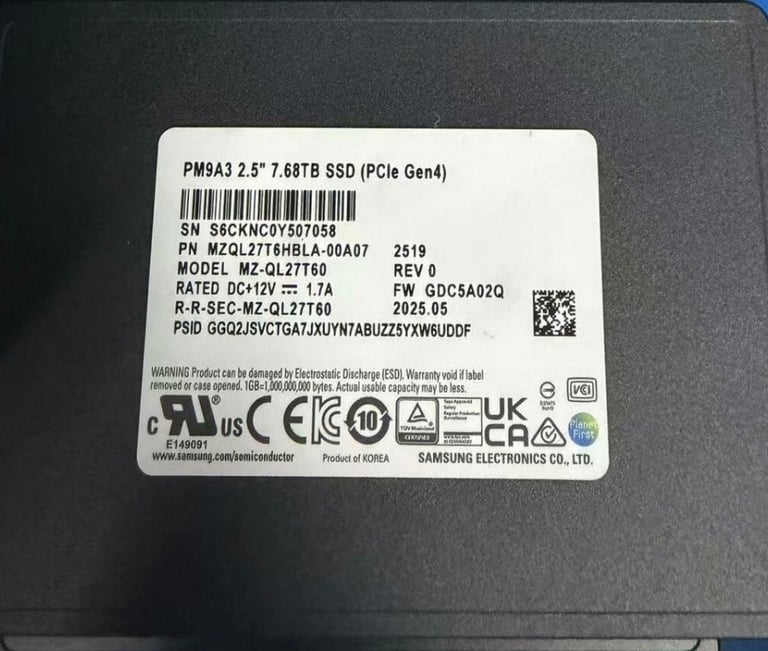
At first glance, strings like MZQLB960HBJR-00W07, SSDPF2KE064T1K3, or MTFDHBE7T6TDF-1AW1ZABYY may look cryptic—almost like serial codes lost in translation. But within the storage industry, these identifiers carry meaning, precision, and intent. They define performance classes, interfaces, endurance ratings, and deployment scenarios.
And in enterprise environments, details matter. A lot.
A single mismatch—whether in firmware, interface, or workload expectation—can cascade into inefficiencies. Or worse, downtime.
So this isn’t just a list of SSDs. It’s a map of possibilities.
Enterprise vs Consumer SSD: A Line That Still Matters
Before diving into specific models, it’s worth confronting a persistent misconception: that consumer SSDs can easily replace enterprise-grade drives.
They can’t. Not really.
Enterprise SSDs are engineered for:
Sustained workloads
Predictable latency under pressure
Higher write endurance
Advanced error correction
Power loss protection
Consumer SSDs, on the other hand, are optimized for burst performance—fast, yes, but not necessarily stable under 24/7 stress.
And yet, in hybrid deployments, both categories coexist. Carefully. Strategically.
Decoding the Model Spectrum
Let’s unpack some of the models listed.
Samsung Enterprise Series
Samsung’s enterprise lineup—like PM983a and PM1735—has long been a staple in hyperscale and data center environments.
PM983a 960G U.2
A reliable workhorse. Balanced performance. Ideal for read-heavy workloads.PM1735 6.4T AIC
A different beast entirely. PCIe Gen4. High throughput. Designed for demanding applications like AI inference or real-time analytics.
The naming may be opaque, but the intent is clear: segmentation by workload.
Intel and Solidigm: Continuity and Evolution
Intel’s NAND business transition to Solidigm didn’t disrupt the ecosystem—it refined it.
Intel Legacy Models
P4610 3.2T U.2
Known for stability. Widely deployed. Still relevant.P5620 6.4T U.2 (Cisco)
Optimized for enterprise integration. Often tied to specific OEM ecosystems.P5520 15.36T U.2 (Cisco)
High-capacity, high-density. Built for scale.
Solidigm Continuation
S4520 7.68T SATA
SATA isn’t dead—it’s just specialized. Perfect for archival or read-heavy tiers.P5520 3.84T U.2
A continuation of Intel’s lineage, but with refined firmware and efficiency.
The transition from Intel to Solidigm didn’t change the DNA. It enhanced it.
Micron’s Quiet Strength
Micron doesn’t always dominate headlines, but its 7300 PRO series deserves attention.
7300 PRO 3.84T / 7.68T U.2
Consistent. Reliable. Often chosen for balanced workloads.
Micron’s strength lies in predictability. And in enterprise storage, predictability is gold.
Kioxia and the SAS Revival
SAS may seem legacy, but in many enterprise environments, it remains indispensable.
Kioxia PM7 3.84T SAS
Built for dual-port environments. High availability. Redundancy.
SAS drives don’t chase headline speeds. They deliver stability where it matters most.
Western Digital: Bridging Performance and Scale
Western Digital’s enterprise SSDs—like SN630 and SN640—occupy a unique space.
SN630 960G U.2
Entry-level enterprise. Efficient. Cost-effective.SN640 7.68T U.2
High capacity. Designed for scaling storage layers.
WD often balances cost and capability, making it attractive for large deployments.
Micron and Kioxia Codes: Precision Engineering
Let’s not overlook models like:
MTFDHBE3T8TDF-1AW1ZABYY
MTFDHBE7T6TDF-1AW1ZABYY
KPM7WRUG3T84
These aren’t just identifiers—they encode:
NAND type
Interface
Capacity
Firmware version
For procurement teams, decoding these is not optional. It’s essential.
U.2, AIC, SATA, SAS: Interface Matters
Choosing the right SSD isn’t just about capacity.
Interface defines behavior.
U.2 (NVMe) → Balanced, hot-swappable, enterprise standard
AIC (Add-in Card) → Maximum performance, less flexibility
SATA → Cost-efficient, lower performance
SAS → Redundancy, dual-port reliability
Each has its place. Misplacing them leads to inefficiency.
Deployment Reality: More Than Just Specs
On paper, everything aligns.
In reality, things get complicated.
Mixed batches. Firmware mismatches. Delayed shipments.
A deployment that should take days stretches into weeks.
Because having SSDs isn’t the same as being able to deploy them.
SZ / HK Delivery: Why It Matters
Logistics isn’t glamorous. But it’s critical.
Offering delivery via Shenzhen (SZ) or Hong Kong (HK) provides:
Faster turnaround
Flexible customs handling
Reduced lead times
In fast-moving projects, this flexibility can make or break timelines.
New vs Refurbished: A Line You Shouldn’t Blur
All listed products are brand new.
That distinction matters.
Refurbished drives may be cheaper, but they carry:
Unknown wear levels
Shorter lifespan
Higher failure risk
In enterprise environments, reliability outweighs savings.
Every time.
Matching SSDs to Workloads
Not all SSDs are created equal.
Read-heavy workloads → PM983a, SN630
Mixed workloads → P4610, 7300 PRO
Write-intensive tasks → PM1735, P5520
Archival storage → S4520 SATA
Choosing the wrong drive isn’t just inefficient—it’s expensive.
The Cost of Getting It Wrong
A mismatched SSD deployment can lead to:
Performance bottlenecks
Increased latency
Higher failure rates
Operational delays
And these costs compound over time.
Why Supply Chain Matters More Than Ever
Even the best SSD is useless if:
It arrives late
It’s from a mixed batch
It doesn’t match firmware requirements
Supply chain integrity is no longer a backend concern—it’s a frontline priority.
Leon Wholesale: Bridging Supply and Deployment
At Leon Wholesale, the focus isn’t just on supplying SSDs.
It’s about ensuring they are:
Consistent
Verified
Ready to deploy
From Samsung PM series to Intel/Solidigm enterprise drives, from Micron U.2 SSDs to Kioxia SAS solutions, the goal is simple:
Deliver storage that works. Immediately.
Final Thoughts: From Inventory to Impact
Enterprise storage is evolving.
It’s no longer enough to have stock.
The real question is:
Can you deploy it without friction?
Because in today’s data-driven world, speed isn’t just about performance.
It’s about readiness.
Contact Leon Wholesale
📱 WhatsApp: +8618136773114
📧 Email: leonxu0317@gmail.com
Hashtags
#EnterpriseSSD #NVMe #DataCenter #StorageSolutions #ITProcurement #Solidigm #Micron #SamsungSSD #Kioxia #WesternDigital #ServerStorage #SupplyChain #LeonWholesale